


Looking at Cell Functions
 All cells have a purpose. If they don't do anything productive, they are not needed anymore. In the big picture, a cell's purpose is much more important than acting as small organizational pieces. They had their purpose long before they started working together in groups and building more advanced organisms. When alone, a cell's main purpose is to survive.
Even if you were a single cell, you would have a purpose. You would have to survive. You would be moving around (probably in a liquid) and just trying to stay alive. You would have all of your pieces inside of you. If you were missing a piece you needed to survive, you would die. Scientists call those pieces organelles. Organelles are groups of complex molecules that help a cell survive.
All Cells are not Created Equal
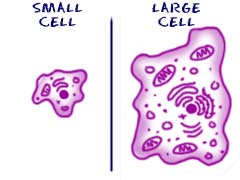
 In the same way that cells survive in different ways; all cells have different types and amounts of organelles. The larger a cell becomes the more organelles it will need. It makes sense if you think about it. If you are a big cell, you will need to eat more than a little cell. You will also need to convert that food into energy. A larger cell would need to eat more and may wind up having more mitochondria to process that food into energy.
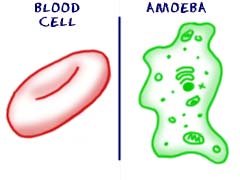
While they might have a purpose, more advanced cells have a difficult time surviving on their own. A cell from your brain could not survive in a Petri dish for long. It doesn't have the right pieces to live on its own. It does have the ability to transmit electrical systems around your body. An amoeba could survive in a dish forever, thrive, and reproduce. On the other hand, that amoeba will never help you transmit electrical impulses. The brain cell is far more advanced and has specific abilities and organelles. Simpler cells have a better chance of surviving on their own while complex cells can accomplish tasks that are more advanced.
► NEXT PAGE ON CELL FUNCTIONS
► NEXT STOP ON SITE TOUR
► RETURN TO TOP OF PAGE
► Or search the sites...
► NEXT STOP ON SITE TOUR
► RETURN TO TOP OF PAGE
► Or search the sites...
Related Video...
Our World: Radiation and You (NASA eClips Video)
Wikipedia:
http://en.wikipedia.org/wiki/Cell_(biology)
Encyclopædia Britannica (Function of Cells):
http://www.britannica.com/EBchecked/topic/101396/cell/37353/The-nature-and-function-of-cells
- Overview
- Passive Trans.
- Active Transport
- Phagocytosis
- Pinocytosis
- Mitosis
- Meiosis
- Cell Structures
- More Topics


 See the full list of biology topics at the site map!
©copyright 1997-2018 Andrew Rader Studios, All rights reserved.
Current Page: Biology4Kids.com | Cell Functions | Overview
** Andrew Rader Studios does not monitor or review the content available at external web sites. They are paid advertisements and neither partners nor recommended web sites. Also, we do not collect or ask for personally identifiable information on any of our sites. Privacy Policy/Terms & Conditions