


Labels and Naming
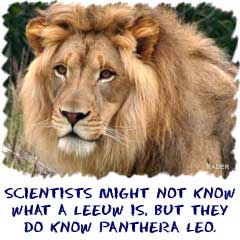 If you look on the shelves, you will see cans and jars that are labeled. If you look on your computer, you will see a label. Those labels tell you something about the thing in front of you. In the same way that objects have labels, scientists have created labels for all the living things on Earth. This naming system allows scientists across the planet to know which organism is which. While one culture may call a lion a lion, another culture may call it löwe. Across the planet, scientists can all use the same name Panthera leo.
About the Names
All of the labels in the taxonometric naming system have different parts. They describe the organism in a series of general names to specific names. The order is KINGDOM (really really big), PHYLUM/DIVISION (divisions used for plants and fungi), CLASS, ORDER, FAMILY, GENUS (genera if more than one), SPECIES (very very specific), and VARIETY (for geographic isolation).There is an old trick to memorize the order. Use the phrase "King Phillip Commands Order For Governing Simply." (So much easier.) Just remember the phrase and notice that the first letters match the order of the naming system - KPCOFGS. You're done. Now you will always know the order.
Even Larger than Kingdoms
Although we regularly use the term kingdom as the largest grouping of species, there is something larger than a kingdom. Kingdoms fall under the larger grouping called DOMAINS. There are three domains used in modern classification. The domain EUKARYA is used for all eukaryotic species that include protists, fungi, plants, and animals. The two domains BACTERIA and ARCHEA are used to group two different types of prokaryote organisms. They are in different domains because differences on a molecular level.If you want to memorize it with that phrase just say "Dorky King Phillip Commands Order For Governing Simply."
What Are Cats and Dogs?
Do you remember about the scientific system of classification? How every living thing is described using a series of words, from a general grouping (kingdom) to a specific one (species)? Well here is how scientists would describe a cat. Remember that only the last two words are used in the binomial naming system.ANIMALIA -- CHORDATA -- MAMMALIA -- CARNIVORA -- FELIDAE -- FELIS -- CATUS
And then there is a dog...
ANIMALIA -- CHORDATA -- MAMMALIA -- CARNIVORA -- CANIDAE -- CANIS -- FAMILIARUS
If you look at the names, you will see that they are very similar, down to the last three parts. But look how different they are when they sit in front of you. Big differences.
Related Video...
Carl Linnaeus (London Nat. History Museum Video)
Encyclopedia.com (Systematics):
http://www.encyclopedia.com/topic/Systematics.aspx
Wikipedia (Binomial Nomenclature):
http://en.wikipedia.org/wiki/Binomial_nomenclature
Encyclopædia Britannica (Nomenclature):
http://www.britannica.com/EBchecked/topic/584695/taxonomy/48698/Nomenclature
- Scientific Method
- Logic
- History of Logic
- Taxonomy
- Labels
- Kingdoms
- Species
- Relationships
- Evolution
- Humans
- Careers
- More Topics


 See the full list of biology topics at the site map!
©copyright 1997-2018 Andrew Rader Studios, All rights reserved.
Current Page: Biology4Kids.com | Scientific Studies | Labels and Naming Systems
** Andrew Rader Studios does not monitor or review the content available at external web sites. They are paid advertisements and neither partners nor recommended web sites. Also, we do not collect or ask for personally identifiable information on any of our sites. Privacy Policy/Terms & Conditions